



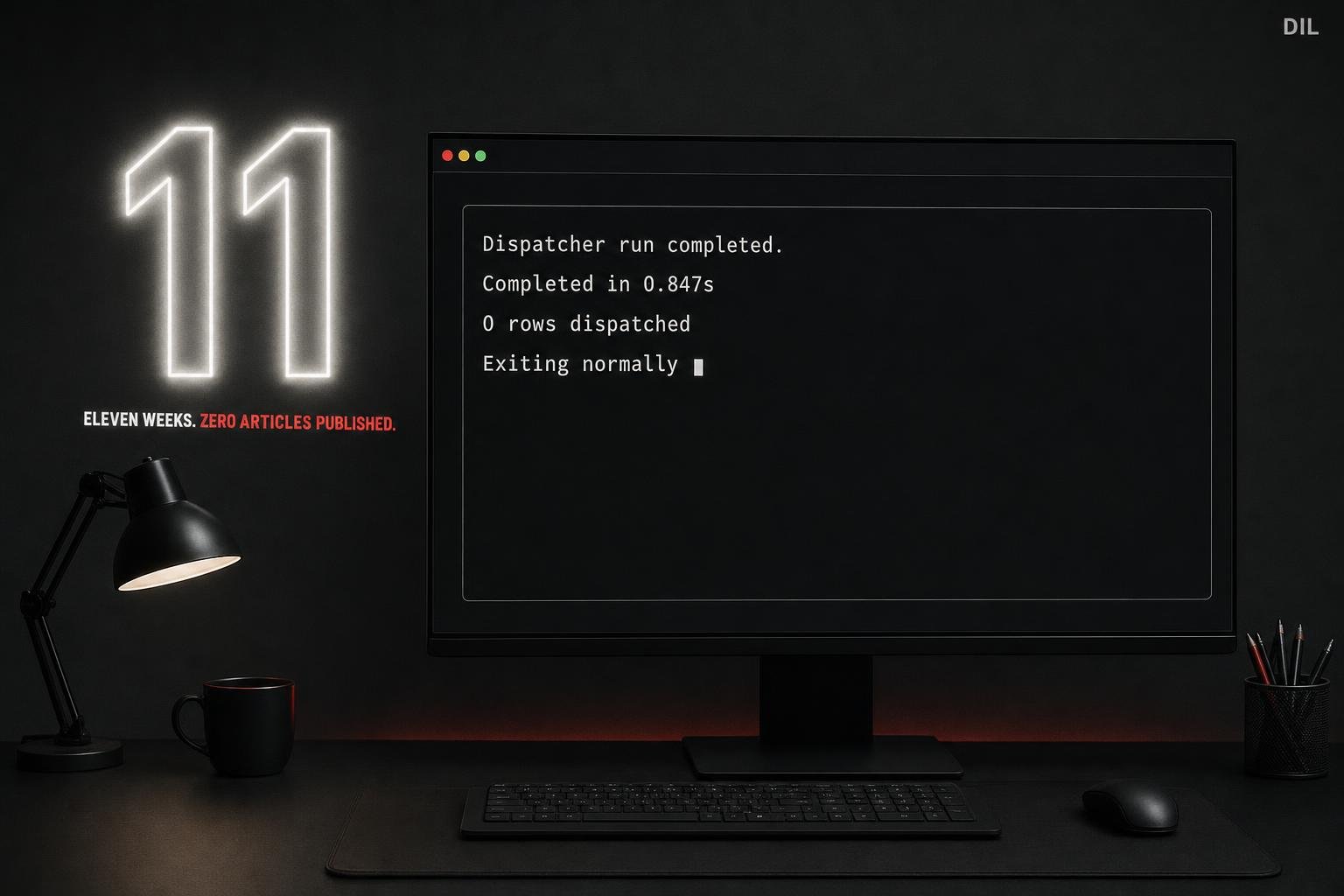
The Drainiacs content pipeline ran its 07:00 dispatcher every single day from early August through to late October 2026. Every run exited cleanly. Nothing published. The queue had been empty since 5 August and nobody had set up an automated way to refill it.
What the Pipeline Actually Does
The dispatcher picks up rows marked Queued and turns them into published articles. It runs at 07:00 daily and takes two rows per day when they exist.
- Queue source: briefs written by a refill skill, appended as rows into a shared queue.
- Publish cadence: two rows consumed per day at 07:00.
- Refill step: a separate skill, run by hand, not on a schedule.
The refill skill was last run manually on 20 July 2026. After that, the queue drained naturally. The last row cleared on 5 August.
The Signal Everyone Missed
A dispatcher run that finishes in under one second dispatched nothing. That is documented behaviour in the AGENTS.md for this project. The job does not error. It does not warn loudly. It just finds zero rows, exits cleanly, and the run log looks identical to a successful publish.
Exit-code monitoring is useless here. You need to track rows dispatched per run. A zero on a day when the queue should have content is the alert that matters.
Eleven weeks of sub-second runs sat in the logs. All green.
Why the Audit Warnings Did Not Help in Time
There was a daily audit running at 10:00. It did detect the empty queue and it did emit a QUEUE RUNWAY LOW: 0 Queued warning. The problem is that runway findings only email on Mondays, a change made on 30 September.
That means the warnings landed on:
- Monday 5 October
- Monday 12 October
- Monday 19 October
Three separate Monday emails, each saying the queue was empty. By the time the third one arrived, the queue had been dry for eleven weeks. Weekly emails are easy to skim past, especially when the rest of the pipeline looks healthy.
Daily audit, weekly signal. The mismatch is the gap.
The Refill That Should Have Been Automatic
The weekly refill routine was meant to call the refill skill on a schedule. It was never armed. The docs describe it as a routine, but no scheduler ever pointed at it.
This is a common failure mode with manual-first workflows. You build the skill, you document the routine, you run it once to prove it works, and then you move on. The automation step feels like a detail. It is not.
The refill skill itself works fine. On 23 October, Dil ran it by hand and the Queue Appender wrote 11 deduplicated gap briefs as rows 87 to 97. The pipeline started publishing again the next morning.
The skill was never the problem. The missing scheduler call was.
What the Fix Looks Like
The fix has two parts.
Manual refill on 23 October. Eleven gap briefs queued as rows 87 to 97. Pipeline resumed. Immediate problem solved.
A weekly shortlist routine with human approval. Rather than fully automating the refill, the new routine emails a shortlist of candidate briefs once a week. A human approves before anything enters the queue. The Queue Appender only runs after that approval.
This is a deliberate choice. Full automation would risk queuing briefs that are subtly off-brief or duplicated in ways the deduplication step does not catch. The approval step is cheap and it keeps the content quality check in the loop.
The weekly routine also needs to actually be armed this time. That is the lesson.
Runway Maths Worth Knowing
At two rows per day, eleven briefs buys roughly five and a half weeks of runway. That is not a lot of buffer.
- Minimum sensible refill interval: monthly, assuming you want at least two weeks of headroom.
- Comfortable buffer: twenty to thirty rows, which is ten to fifteen weeks at this cadence.
- Warning threshold: email daily, not weekly, when queued rows drop below a week's worth.
The Monday-only email rule made sense as a noise reduction measure. It needs an exception for zero-runway states.
What I'd do differently
- Arm the scheduler before closing the task. The refill routine was documented and tested. The missing step was pointing a scheduler at it. That should be a checklist item, not an afterthought.
- Alert daily on zero-runway, not weekly. The Monday cadence is fine for low-runway warnings. Zero rows is a different severity. It should email the same day it hits zero.
- Log rows dispatched, not just exit code. A sub-second run with zero dispatches should appear in a dashboard somewhere visible, not just in raw logs. If I'd had a simple "articles published today: 0" metric surfaced anywhere, this would have been caught in week one.
- Set a calendar reminder for the first refill after any manual run. Until the scheduler is proven reliable, a recurring calendar event is a reasonable backup. Boring, but it works.